
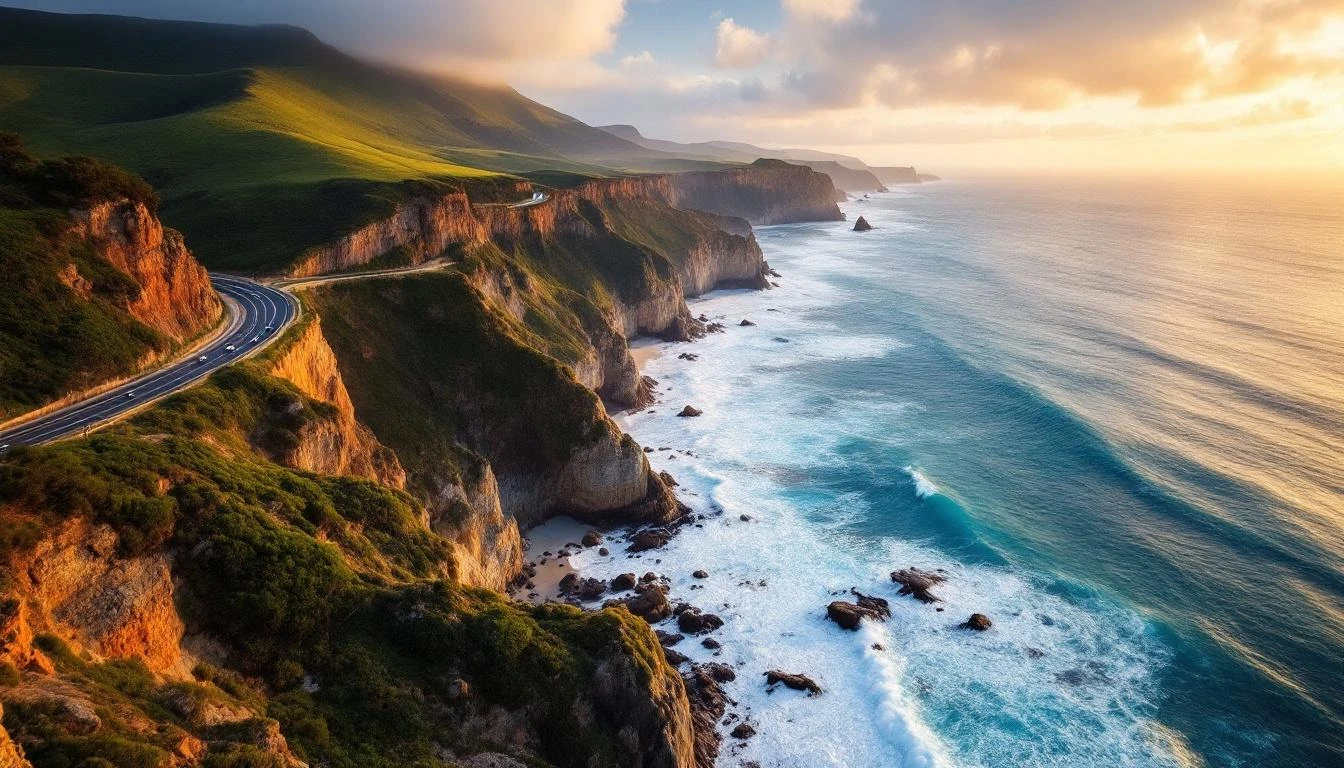
Every major Great Ocean Road stop, mapped
An interactive overview of every meaningful stop along the road — from Bells Beach in the east to Port Fairy in the west — with a full guide behind every dot on the map.
Tap any dot for the full stop guide
The map below is a stylized overview — it's not a navigation map, so use Google Maps or Apple Maps for actual driving. Every dot links to the full page for that stop.
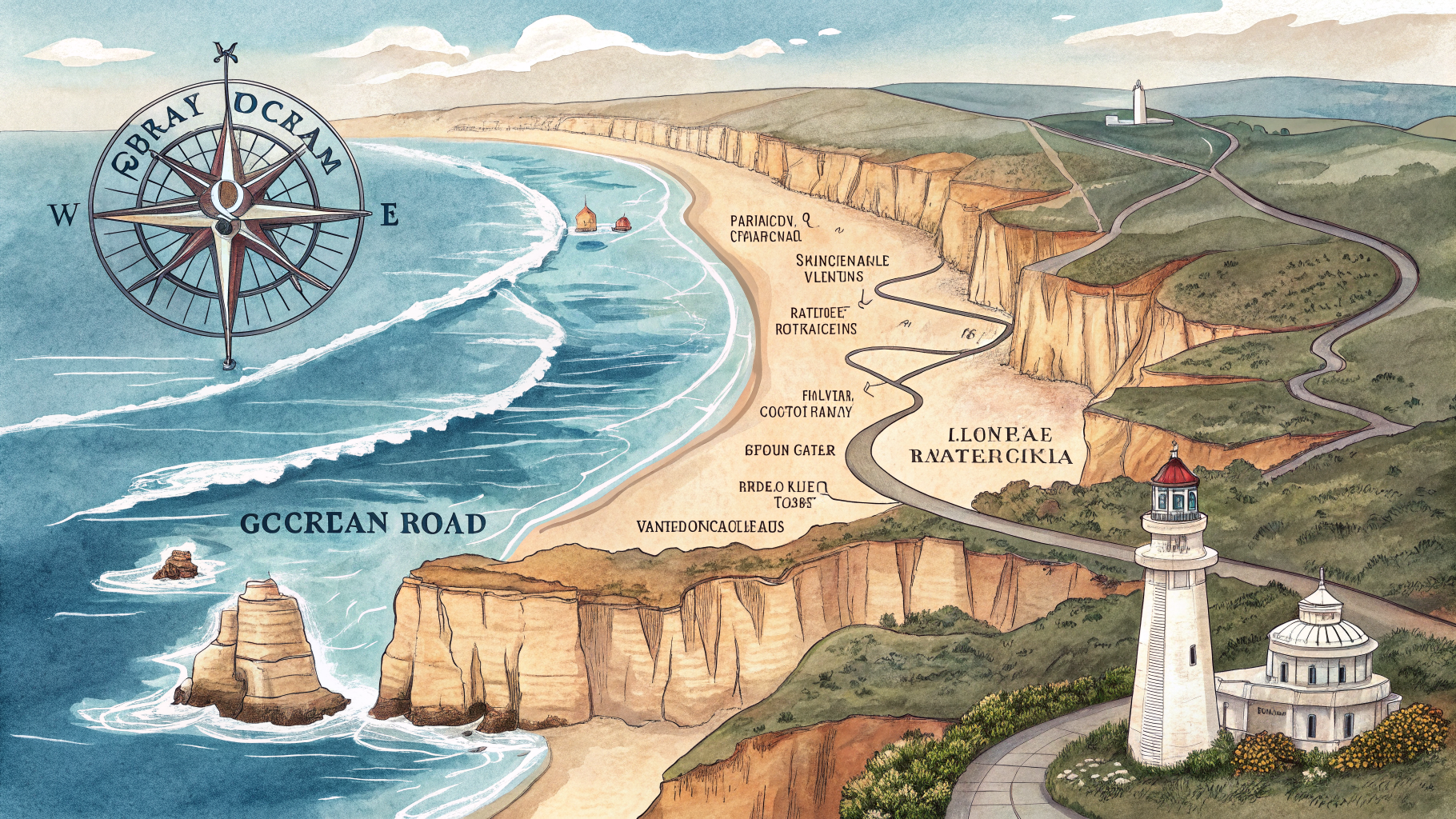
Tap any dot to open the stop guide.
A 243-kilometre drive in three distinct character zones
The Great Ocean Road runs 243 kilometres along Victoria's south-west coast, from Torquay in the east to Allansford near Warrnambool in the west. Along the way, the road passes through three completely different landscapes — and most travellers underestimate how distinct each zone is until they've actually driven it.
The first zone is the Surf Coast, running roughly Torquay to Lorne. This is the busiest, most accessible stretch — wide beaches, surfing icons, and the official photo stops most travellers expect. The road from Torquay through Anglesea, Aireys Inlet and Lorne is the most-driven section, with traffic and amenities to match. Bells Beach, Memorial Arch, Split Point Lighthouse all live here.
The second zone is the Otway region — Lorne through Apollo Bay and inland through the Otway Ranges to Lavers Hill. The road shifts character here. The cliff-side stretch between Lorne and Apollo Bay is the most scenic section of the entire drive: 45 kilometres of tight bends with the Southern Ocean directly below your left side. From Apollo Bay the road heads inland through dense temperate rainforest — the Great Otway National Park, with the Cape Otway Lightstation on a southward detour, the Otway Fly Treetop Walk, and a string of waterfalls.
The third zone is the Shipwreck Coast, from Princetown to Warrnambool — the limestone country dominated by the Twelve Apostles. The same erosion process that created the Apostles produces a dozen other formations along this stretch: Loch Ard Gorge, London Arch, The Grotto, Bay of Islands. If the Surf Coast is the road's social section and the Otways are its forested middle, the Shipwreck Coast is the dramatic finale.
Knowing this three-zone structure changes how you plan stops. Spending an entire morning rushing through the Surf Coast and arriving at the Twelve Apostles tired and mid-afternoon is the most common mistake. Better: structure each day around one zone, with one or two stops in adjacent zones for variety. The 3-day classic itinerary divides the road exactly along these zone boundaries.
Surf Coast stops
From Torquay to Lorne. Wide beaches, surfing icons, the official photo stops, and the most accessible stretch from Melbourne. Plan 1 morning to do this region properly.
Torquay
Surf capital of Australia and the road's official start.
Bells Beach
Australia's most famous surf break and home of the Rip Curl Pro.
Anglesea
Family beach town and the kangaroo-grazed golf course.
Memorial Arch
The wooden gateway marking the road's symbolic start.
Aireys Inlet
Quiet lighthouse town with the famous Round the Twist headland.
Split Point Lighthouse
The 1891 'White Queen' on the Aireys Inlet headland.
Lorne
The road's prettiest town — pier, café strip, swimming bay.
Kennett River
The most reliable wild koala spotting on the road.
Otway stops
From Lorne through Apollo Bay and inland through the rainforest. Koalas, waterfalls, the Otway Fly, and mainland Australia's oldest lighthouse. Plan 1 full day.
Erskine Falls
30-metre waterfall in a tree-fern gully behind Lorne.
Apollo Bay
Midpoint town: working harbour, best food scene, Otway gateway.
Maits Rest
30-min boardwalk loop through soft Otway tree-fern gully.
Cape Otway Lightstation
Mainland Australia's oldest lighthouse, built in 1848.
Great Otway National Park
Towering mountain ash, glow worms and tree-fern rainforest.
Otway Fly Treetop Walk
600-metre steel walkway 25 metres above the canopy.
Triplet Falls
Three-stepped cascade in deep Otway rainforest.
Hopetoun Falls
30-metre cascade with a steep walk-down to the base.
Shipwreck Coast stops
From Princetown to Warrnambool. The limestone country: Twelve Apostles, Loch Ard Gorge, London Arch, and a dozen other formations from the same erosion process. Plan 1 full day.
Gibson Steps
86 steps to the only beach access beneath the Apostles.
Twelve Apostles
Eight limestone giants — the road's signature view.
Loch Ard Gorge
Turquoise cove with a famous 1878 shipwreck story.
Port Campbell
Closest town to the Twelve Apostles — sheltered harbour.
London Arch
Formerly London Bridge — collapsed in 1990.
The Grotto
Sea-arch viewing platform sitting below sea level at high tide.
Bay of Islands
Wide stretch of sea stacks and offshore towers.
Warrnambool
Western end of the road. Whales June–Sept at Logans Beach.
Port Fairy
Historic harbour town with bluestone cottages.
Choosing which stops to skip
Even on a 7-day trip, you can't do justice to every stop on this page. The harder skill is choosing which to skip. A few rules from experienced Great Ocean Road travellers:
- Two stops per region per day, not five. Stopping every 15 minutes flattens the trip into a checklist. Two meaningful stops with time to walk and look are better than five hurried photo dashes.
- Time the Twelve Apostles for sunset. Everything else flexes around this. Arrive 90 minutes before sunset, stay 30 minutes after for blue hour. The reason to stay in Port Campbell or Princetown is to make this work.
- Pick one waterfall, not three. Erskine Falls is the most accessible. Hopetoun Falls is the most photogenic. Triplet Falls is the deepest forest experience. Three is too many for any trip shorter than 7 days.
- Cape Otway is non-negotiable for a 2+ day trip. The koala drive in is the highest-value 12 km on the entire road. Skip it only on a 1-day trip.
- The "minor" Shipwreck Coast stops are quieter and just as good. London Arch, The Grotto, Bay of Islands. The Twelve Apostles will be busy; these won't.
For first-timers, the safe answer is to follow a structured itinerary. The 3-day classic hits the right stops in the right order at the right times of day. The 7-day deep dive covers nearly everything on this page.
Why westbound is the only sensible direction
Drive west — Torquay to Warrnambool. There are three reasons, all of them practical:
The lookouts are on the ocean side. Almost every pull-off, viewpoint, and beach access on the Great Ocean Road sits on the south side of the road. Driving westbound puts your car on the same side as those pull-offs, so you can pull in safely without crossing oncoming traffic. Driving east-bound, you'd be making constant right turns across the highway, which is both slower and less safe.
You arrive at the Twelve Apostles in late afternoon. The stacks face roughly south-west, so the seaward face — the one you photograph — lights up amber from late afternoon into sunset. Reach them earlier in the day and the light is flat or back-lit. Driving westbound naturally puts you there in the right window.
The road's most dramatic stretches come last. Driving west, the road builds. The Surf Coast feels established and busy; the cliff section south of Lorne starts feeling adventurous; the Otway forest feels remote; the Shipwreck Coast at sunset is the climax. Drive east-bound and the trip peaks in the first hour and decompresses through forgettable Surf Coast suburbs.
The east-bound exception is sunrise photography at the Twelve Apostles — the first light hits from the east. If you're doing a sunrise-focused trip, base in Port Campbell, drive east as a day loop, and stay flexible on the rest.
Six stops that don't get the attention they deserve
Most travellers head straight for the famous viewpoints and miss these. None require a detour — they're all on or just off the main road.
-
The Razorback
Thin limestone ridge a 10-minute walk from the Loch Ard Gorge car park. Most travellers walk past it on the way to the main viewpoint.
-
Mariners Lookout
Five-minute drive from Apollo Bay. The aerial-style view of the entire bay. Best at sunrise.
-
Cape Patton Lookout
Best cliff-top view between Lorne and Apollo Bay. Pull off, walk 50 metres to the platform.
-
Maits Rest
30-minute boardwalk loop through tree-fern gully. Step-free. The Otway rainforest experience without the long walk.
-
The Grotto
Sea-arch viewing platform that sits below sea level at high tide. Quieter than the Apostles, more interactive.
-
Logans Beach Whale Nursery
Warrnambool. Southern right whales calve in the shallows below the cliff platform from June to September.
Great Ocean Road stops FAQs
- How many stops should you make on the Great Ocean Road?
- For a 3-day trip, plan around 12–15 meaningful stops. That's enough to cover the highlights (Memorial Arch, Lorne, Apollo Bay, Cape Otway, Twelve Apostles, Loch Ard Gorge, Port Campbell, plus 5–7 others) without rushing. For a 7-day trip, 25+ stops is realistic. The full list of major stops on this page is around 25 — most travellers won't fit them all into a single trip.
- What are the must-see stops on the Great Ocean Road?
- The non-negotiables: Memorial Arch (the road's symbolic start), Bells Beach (Australia's most famous surf break), Lorne (the prettiest town), Apollo Bay (food + Otway gateway), Cape Otway Lightstation (mainland's oldest lighthouse + koalas), Twelve Apostles (the signature view), Loch Ard Gorge (turquoise cove + shipwreck story), Port Campbell (closest base to the Apostles). Eight stops, each genuinely irreplaceable.
- Are the Twelve Apostles the most popular stop on the Great Ocean Road?
- Yes — by some distance. Roughly 70% of all Great Ocean Road searches and visits centre on the Twelve Apostles. The lookouts hold thousands of visitors at peak times in summer; in autumn or winter you may have them nearly to yourself at sunrise. The Apostles are also the photographic anchor that almost every other stop is judged against.
- Which stops are free on the Great Ocean Road?
- The vast majority. Free entry: Twelve Apostles, Loch Ard Gorge, Memorial Arch, Bells Beach lookout, Gibson Steps, London Arch, The Grotto, Bay of Islands, every town beach, every public lookout. Paid entry: Cape Otway Lightstation precinct (~AU$20/adult), Otway Fly Treetop Walk (~AU$30/adult), Split Point Lighthouse tower tour (~AU$20/adult). Parks Victoria fees apply at some Otway camping grounds.
- Can you do all the Great Ocean Road stops in one day?
- No, comfortably. Even visiting the top 8 stops in a single day from Melbourne is a 12-hour ordeal — and you'd be at most stops for under 20 minutes. To genuinely visit each major stop properly, you need at least 3 days. To visit all the stops on this page, plan a full week.
- Are there hidden stops most travellers miss?
- Yes. The Razorback (a thin limestone ridge near Loch Ard Gorge), Mariners Lookout (above Apollo Bay), Wild Dog Cove (10 km east of Apollo Bay), Maits Rest Rainforest Walk (a 30-min loop most rush past), Sheoak Falls (Lorne hinterland), and the Loch Ard cemetery walk. None are hidden in the strict sense — they're signposted — but they're skipped by travellers chasing the famous viewpoints.
- What's the best order to do the Great Ocean Road stops?
- East to west — Torquay to Warrnambool. Drive westbound. Most lookouts and pull-offs are on the ocean side of the road, which is the left when you're heading west, so you pull in safely. You'll also reach the Twelve Apostles in late afternoon, which is the strongest light of the day for the seaward face of the stacks.
- Are the Great Ocean Road stops accessible for travellers with mobility needs?
- Most major lookouts (Twelve Apostles, Loch Ard Gorge cliff-top, Memorial Arch, The Grotto upper viewpoint) are fully step-free. The beach descents (Gibson Steps, Loch Ard Gorge beach) and waterfall walks (Erskine Falls, Hopetoun Falls) involve substantial stairs and are not wheelchair accessible. Maits Rest Rainforest Walk, Cape Otway Lightstation grounds, and the cliff-top sections of most viewpoints are step-free.
Now plan the trip itself
Knowing the stops is half the work. The 3-day classic itinerary times every move so you arrive at each stop in the right light, with the right amount of energy.