
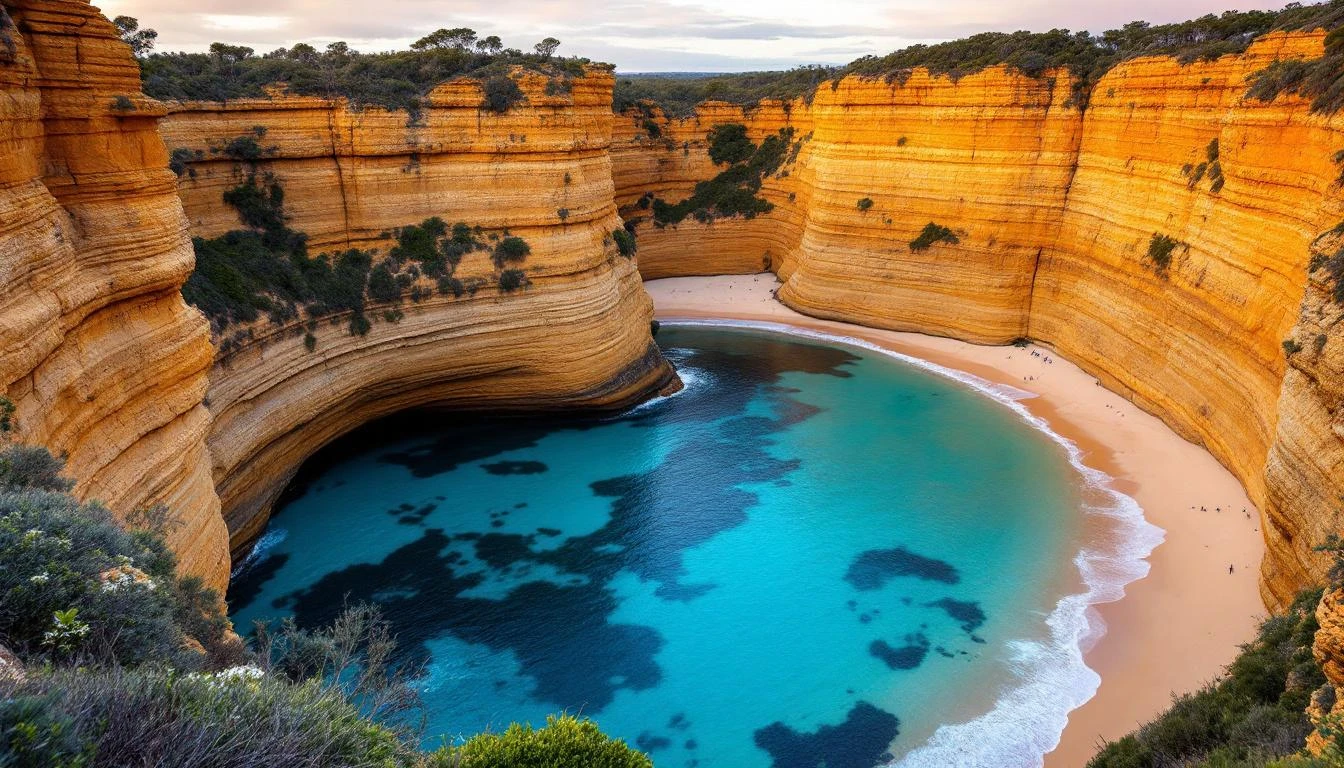
Loch Ard Gorge
Turquoise water, 70-metre limestone walls, white-sand beach, and one of Australia's most haunting 19th-century shipwreck stories.
A hidden cove the Southern Ocean carved out in slow motion
Loch Ard Gorge is what happens when the same erosion that built the Twelve Apostles works inland. The gorge began as a cave in the Miocene limestone cliffs, expanded into an arch, then collapsed into a sea-walled amphitheatre — a near-circular cove with sheer 70-metre walls on three sides and a narrow opening to the open Southern Ocean.
The result is one of the most photogenic spots on the entire road. From the cliff-top viewpoint you look down into a cove of vivid turquoise water, fringed by a thin crescent of white sand. Mutton Bird Island sits offshore, riddled with caves where short-tailed shearwaters nest in the millions. From mid-September to April you can watch them stream back to the island at dusk in tight black ribbons.
Most travellers stop at the main viewpoint and move on. The full Loch Ard Gorge area has at least six distinct lookouts and a beach descent — taken together, they tell the story of the entire Shipwreck Coast, not just the photo at the top.
Great Ocean Road tours and activities
Browse tours focused on the Great Ocean Road, the Twelve Apostles and the Otways.
Great Ocean Road
Some links are affiliate links — we may earn a commission at no extra cost to you.
The night that gave the gorge its name
On 1 June 1878 the clipper ship Loch Ard was three days out of London, sailing through fog along this exact stretch of coast on the final leg of a 91-day voyage to Melbourne. The captain misjudged his position. At 4am the ship struck Mutton Bird Island and broke apart in heavy seas. Of the 54 people on board, 52 drowned in the dark.
The two survivors were 18-year-old apprentice sailor Tom Pearce and 19-year-old passenger Eva Carmichael, who had been travelling with her family — all of whom died. Pearce was washed into the gorge clinging to wreckage and pulled himself onto the beach. Hearing Eva's screams from the surf, he swam back out and dragged her into the cove, where they sheltered in a small cave for several hours before he climbed the 70-metre cliff for help.
The story made international news. The Loch Ard cemetery — where four of the recovered victims are buried — sits within the gorge area, and a memorial path leads through it. Tom and Eva never married despite Victorian-era press speculation. He became a sea captain. She returned to Ireland and never spoke publicly of the wreck again.
Some of the recovered cargo, including the famous Loch Ard Peacock — a 1.5-metre porcelain bird being shipped to the Melbourne Exhibition — is now in the Flagstaff Hill Maritime Museum in Warrnambool.
The six-stop walking circuit
The car park is on the inland side of the road. From there, paved paths radiate out to the various lookouts. Don't just stop at the gorge — do the full circuit. You can walk it all in 90 minutes.
- Loch Ard Gorge main viewpoint — the postcard. Faces east, best in morning light.
- Beach access stairs — 100+ wooden steps descending to the cove floor. Touch the same sand Tom and Eva washed up on.
- Loch Ard cemetery — short path through coastal heath, four graves and an interpretation board.
- Mutton Bird Island viewpoint — looks out at the actual wreck site. Best at dusk Sep–Apr for the shearwater return.
- Tom and Eva lookout — sits directly above where Pearce climbed the cliff.
- The Razorback — a thin ridge of limestone almost back at the car park. Ten-minute walk along a clifftop, often skipped.
Wear closed shoes. The boardwalks have railings but the stair descent to the beach is steep. There is no swimming — strong currents push directly through the gorge mouth even on calm days.
Getting the most out of the cove
The gorge faces roughly east — meaning it's in shadow during the late-afternoon golden hour that suits the Apostles. For the strongest light on the turquoise water, aim for between 10am and 1pm. The high sun penetrates deeper into the cove and makes the water glow.
From the main viewpoint, a 24mm lens captures the full cove with cliff context. Bring a polariser — it cuts through the surface glare and saturates the water colour dramatically. Shoot at f/8 or f/11 for edge-to-edge sharpness.
The strongest alternate composition is from the beach itself, looking up. The 70-metre walls dwarf you and the cove mouth frames the open ocean beyond. Use the wet sand as a leading line. Time it for low tide — high tide swallows most of the beach.
For the Mutton Bird Island return at dusk (Sep–Apr), use a long lens (200mm+) to compress the shearwater silhouettes against the sky. Sit at the Mutton Bird viewpoint about 30 minutes before official sunset.
Sister attractions on the Shipwreck Coast
Loch Ard Gorge is the heart of a 12-kilometre stretch of coastal erosion that contains six distinct world-class formations. The full Shipwreck Coast is best done as a single afternoon loop:
Twelve Apostles
4 km east. The signature stop — best at sunset, when the seaward face of the stacks lights up amber.
Twelve Apostles guide →Gibson Steps
2 km east. The only beach access beneath the Apostles. 86 wooden steps cut into the cliff.
Gibson Steps guide →London Arch
8 km west. Formerly London Bridge — the inland span collapsed in 1990. Quieter than the Apostles, just as dramatic.
London Arch guide →Loch Ard Gorge FAQs
- Where is Loch Ard Gorge?
- Loch Ard Gorge sits in Port Campbell National Park, about 4 kilometres west of the Twelve Apostles main lookout on the Great Ocean Road. The car park is signposted from the highway and free to use. From there, paved paths lead to multiple cliff-top viewpoints and a wooden staircase descending to the beach inside the gorge itself.
- What is the Loch Ard shipwreck story?
- On 1 June 1878, the clipper ship Loch Ard struck Mutton Bird Island just outside the gorge, killing 52 of the 54 people on board. The two survivors — 18-year-old apprentice sailor Tom Pearce and 19-year-old passenger Eva Carmichael — washed into the gorge that now bears the ship's name. Pearce climbed the cliff for help; Eva was rescued from a small cave on the beach. Their story made international headlines and became one of the most famous shipwreck rescues in Australian history.
- Can you walk down to the beach at Loch Ard Gorge?
- Yes. A wooden staircase from the upper viewpoint takes you down to the cove's small white-sand beach — about 100 steps each way. The beach is open for walking but swimming is not advised due to dangerous swells and undertows. Even on calm days the waves can pulse unpredictably. Stay above the wet sand line.
- How long should you spend at Loch Ard Gorge?
- Allow at least 90 minutes to experience the full site properly. The full circuit covers the main gorge viewpoint, the beach descent, the Tom and Eva memorial, the Mutton Bird Island viewpoint, the wreck of the Loch Ard cemetery, and the Razorback. You can rush the gorge itself in 30 minutes, but you'll miss most of the area.
- What's the best time of day to visit Loch Ard Gorge?
- Mid-morning to early afternoon, when the sun is high enough to light up the turquoise water inside the cove. The gorge faces east, so it's in shadow during the late-afternoon golden hour that works for the Twelve Apostles. Plan to do Loch Ard Gorge first, then move to the Apostles for sunset.
- Is Loch Ard Gorge wheelchair accessible?
- The cliff-top viewpoints and the path to the gorge lookout are step-free and paved. The descent to the beach itself is via 100+ wooden steps and is not wheelchair accessible. The accessible viewpoints still offer the best photographic angle — you don't need to descend to capture the cove.
- Are there facilities at Loch Ard Gorge?
- There are public toilets and a small interpretation shelter at the car park, plus picnic tables. There is no café or food on-site — the closest options are 12 km west in Port Campbell or at the Twelve Apostles visitor centre 4 km east.
- Can you stay overnight near Loch Ard Gorge?
- Camping is not permitted in the national park itself. The closest accommodation is in Port Campbell (12 km / 12 minutes' drive west) or Princetown (10 km / 10 minutes east). Both have motels, B&Bs and holiday rentals; Port Campbell has a wider selection and proper restaurants.
Visit the gorge as part of the full Shipwreck Coast loop
The 3-day classic itinerary times this stretch perfectly — Loch Ard Gorge in morning light, the Apostles for sunset.