
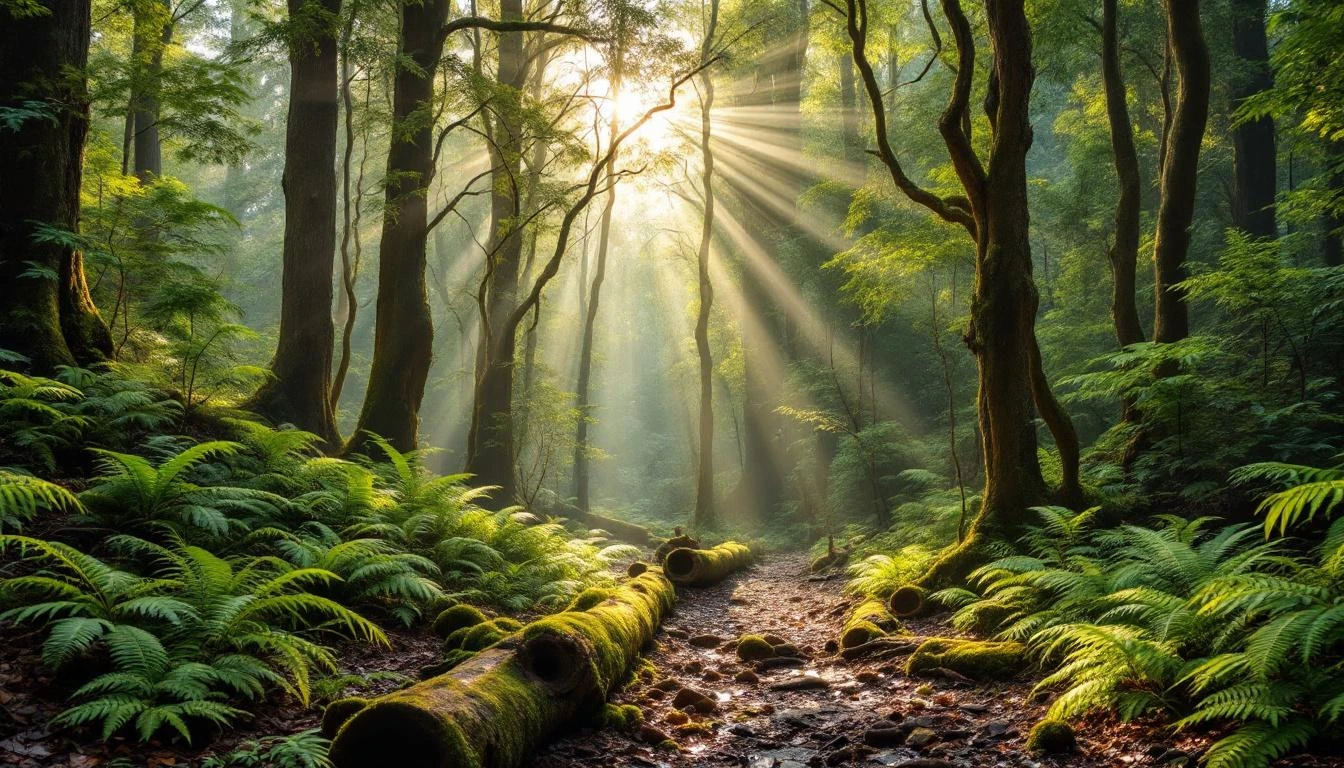
Great Otway National Park
240,000 hectares of temperate rainforest, mountain ash, waterfalls, koala-thick forest and the canopy walkway — the Great Ocean Road's wild interior.
A rainforest the size of a small country
The Great Otway National Park is one of Victoria's largest, covering 240,000 hectares of the Otway Ranges and a coastal strip from near Anglesea to Princetown. It contains some of Australia's tallest hardwood forest — mountain ash trees that routinely exceed 80 metres, second only to the California redwoods globally. Beneath the canopy, dense temperate rainforest of myrtle beech, blackwood, soft tree ferns, and moss-covered fallen logs creates a humid, prehistoric environment that feels distinctly older than the surrounding farmland.
For Great Ocean Road travellers, the park is the green hinterland behind the towns. From Lorne, the park is fifteen minutes inland; from Apollo Bay, the park begins immediately at the town's edge. The road from Apollo Bay through Lavers Hill to Princetown threads directly through the heart of the park — the most scenic inland section of the entire Great Ocean Road drive.
Within the park, the highlights cluster into four groups: the waterfalls (around ten of them, ranging from easy roadside stops to multi-hour hikes); the koala forest at Cape Otway and Kennett River; the visitor-engineered attractions like the Otway Fly Treetop Walk and the Cape Otway Lightstation; and the Great Ocean Walk — the 110 km thru-hike that runs from Apollo Bay to the Twelve Apostles. A week in the Otways doesn't exhaust the park; a half-day at minimum is needed to scratch the surface.
The Otway falls shortlist
- Erskine Falls — 30 m, 230 steps to base, 10 min from Lorne. Most accessible.
- Sheoak Falls — short cascade, 30-min return walk, 5 km from Lorne.
- Triplet Falls — 1.5 km loop walk, deep rainforest, 35 min from Apollo Bay.
- Hopetoun Falls — 30 m cascade, steep walk-down, 35 min from Apollo Bay.
- Beauchamp Falls — 45 min from Apollo Bay, longer walk-in, larger volume.
- Marriners Falls — 20 m, 30-min return walk, 15 min from Apollo Bay.
- Stevenson's Falls — 45 min from Apollo Bay, off the beaten path.
- Phantom Falls — 30 min from Lorne, less-visited, technical walk-in.
What else fills a day in the park
- Otway Fly Treetop Walk — 600-metre canopy walkway, 47-metre spiral tower. Family-friendly, accessible.
- Maits Rest Rainforest Walk — 30-minute boardwalk loop. Step-free, the easiest rainforest experience.
- Cape Otway Lightstation — mainland Australia's oldest lighthouse plus the famous koala forest drive.
- Melba Gully — short walk to a glow worm gully, best at night with a torch.
- Triplet Falls walk — 1.5 km loop through one of the densest stands of mountain ash in the park.
- Aire Crossing — picnic spot on the Aire River, popular with families.
- Beauchamp Falls Reserve — secluded camping ground with falls access.
- The Great Ocean Walk — 110 km thru-hike or as day sections.
What lives in the Otway forest
The Otway National Park supports unusually dense populations of several Australian species, partly because the forest is contiguous (less fragmented than most southern Victorian habitats) and partly because the temperate climate suits species that struggle in drier inland forests.
- Wild koalas — densest at Cape Otway and Kennett River. Drive Lighthouse Road or Grey River Road slowly in late afternoon for near-guaranteed sightings.
- Eastern grey kangaroos — common throughout the park, often grazing near roadsides at dawn and dusk.
- Glow worms — Melba Gully holds Australia's largest glow worm population. Visit at night with a torch (red-light filter recommended to avoid disturbing the worms).
- Echidnas — frequently seen on quieter walking tracks, particularly in autumn.
- Wallabies — common in the inland forest sections, less frequent near the coast.
- Birds — yellow-tailed black cockatoos, crimson rosellas, lyrebirds (heard rather than seen). The park is on multiple birdwatching routes.
- Platypus — present in some Otway streams (notably the Aire River) but rarely seen.
See the wildlife guide for ethical viewing principles, the best months for each species, and the most reliable spots.
Visiting the park
Access: Multiple entry points along the Great Ocean Road. No central entry — most visitors enter via Apollo Bay, Lorne, or Lavers Hill, then drive to specific attractions. The park covers a large area; allow drive time between sites.
Best time of year: Autumn (March–May) for the most reliable weather and the best waterfall flow without winter storms. Spring (September–November) for wildflowers and active koala viewing. Winter has the fullest waterfalls but short days. Summer can be dry, with reduced waterfall flow.
Mobile reception: Patchy throughout the park. Telstra works in most areas, but expect dead spots in deep gullies and on the inland Otway tracks. Don't rely on phone navigation — download offline maps before driving in.
Bushfire safety: The Otways are a high-fire-danger area in summer. Check the VicEmergency app on Total Fire Ban days. The park can be partially closed during fire warnings; verify before driving in.
Camping: Multiple Parks Victoria camping grounds inside the park (Aire River, Blanket Bay, Johanna Beach, Sharps Track). Booking required for most. Free camping outside designated areas is not permitted.
How to spend a day in the park
From Lorne (a half-day): Drive to Erskine Falls (15 min). Walk to base and back (45 min). Drive 10 min to Sheoak Falls. Walk (30 min). Coffee back in Lorne by lunchtime.
From Apollo Bay (a full day): Drive south on Lighthouse Road for koala spotting (60 min). Visit Cape Otway Lightstation (90 min). Lunch at the lightstation or back in Apollo Bay. Afternoon: drive inland to Maits Rest (30-min walk) and Triplet Falls (1.5 km loop). Optional: add the Otway Fly for a longer day.
From Apollo Bay (a hiking day): Drive to the Apollo Bay end of the Great Ocean Walk. Walk one of the day sections — Apollo Bay to Marengo (5 km return) or Marengo to Elliott Ridge (12 km return). Pack lunch. Half-day to full-day depending on section.
From Apollo Bay (the full Otway hinterland day): Otway Fly Treetop Walk (90 min). Triplet Falls (45 min). Hopetoun Falls (45 min). Lunch at Lavers Hill Roadhouse. Drive back via Maits Rest. Total: ~6 hours of activity and driving.
Great Otway National Park FAQs
- Where is Great Otway National Park?
- Great Otway National Park covers approximately 240,000 hectares of the Otway Ranges in southern Victoria, between the towns of Anglesea, Apollo Bay, and Princetown. It runs from the Surf Coast in the east to the Shipwreck Coast in the west, sitting inland of the Great Ocean Road for most of its length. Multiple entry points exist — major access via Apollo Bay and Lorne.
- What can you do in Great Otway National Park?
- The park's highlights: walk the Otway Fly Treetop Walk, visit Cape Otway Lightstation, see waterfalls (Erskine, Triplet, Hopetoun, Beauchamp, Sheoak, Marriners), spot wild koalas at Cape Otway and Kennett River, do sections of the Great Ocean Walk, see glow worms at Melba Gully, walk the Maits Rest rainforest boardwalk. The park supports a full week of activities.
- Is Great Otway National Park free to visit?
- Most of the park is free — walking tracks, waterfalls, lookouts, and most attractions have no entry fee. Paid attractions inside the park include the Otway Fly Treetop Walk (~AU$30/adult), the Cape Otway Lightstation precinct (~AU$20/adult), and some Parks Victoria camping grounds. Day visitors driving the Great Ocean Road through the park don't need any pass.
- What waterfalls are in the Otway National Park?
- Erskine Falls (10 min from Lorne, the most accessible), Sheoak Falls (5 km from Lorne), Triplet Falls (35 min from Apollo Bay, deep rainforest), Hopetoun Falls (35 min from Apollo Bay, steep walk-down), Beauchamp Falls (45 min from Apollo Bay, larger walk-in), Marriners Falls (15 min from Apollo Bay), Stevenson's Falls (45 min from Apollo Bay), Phantom Falls (30 min from Lorne, off the beaten track).
- Where can you see koalas in the Otway National Park?
- Cape Otway is the most reliable spot — drive Lighthouse Road slowly through the manna gum forest. Kennett River (Grey River Road) is the second-most reliable. Late afternoon (the last 90 minutes before sunset) is the best time. The Cape Otway koala population is recovering from a population stress event some years ago; the animals can be thin. Don't approach closely or feed them.
- Can you camp in Great Otway National Park?
- Yes — Parks Victoria operates several camping grounds inside the park. The popular options include Aire River, Blanket Bay, Johanna Beach, and Sharps Track. Booking through the Parks Victoria website is required for most sites. Free camping outside designated grounds is not permitted within the park boundary.
- How big is Great Otway National Park?
- About 240,000 hectares — one of Victoria's largest national parks. It includes the entire western Otway Ranges plus a coastal strip running from near Anglesea to Princetown. The park's elevation ranges from sea level along the coast to over 600 metres at the highest peaks. It contains some of Australia's tallest hardwood forest.
- Is Great Otway National Park accessible for less mobile visitors?
- Several attractions inside the park are step-free and accessible: the upper Erskine Falls platform, Maits Rest Rainforest boardwalk, the Otway Fly main walkway, the Cape Otway Lightstation grounds (most paths). The waterfall descents (Erskine to base, Hopetoun) and the Otway Fly tower are not accessible. Plan around the accessible options if mobility is a constraint.