
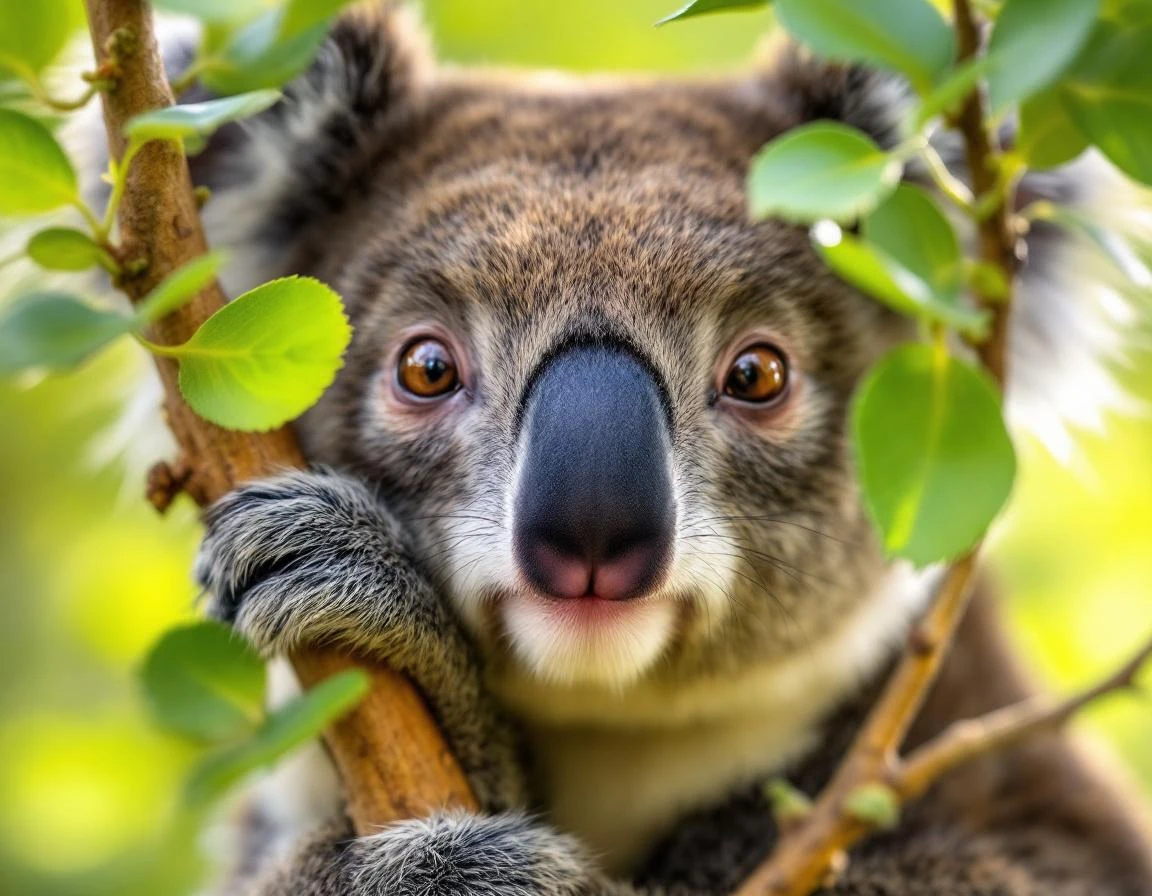
Wild koalas on the Great Ocean Road
Two proven spots, one essential time window, and a set of ethical viewing rules that turn wishful spotting into near-guaranteed sightings.
Cape Otway and Kennett River
Wild koalas live across the Otway Ranges and along the entire Surf Coast, but two spots stand out as reliable enough to plan a trip around. Both have free road access, dense manna gum populations (the koala's preferred food source), and predictable koala behaviour during the right time of day.
Cape Otway is the more famous spot. Lighthouse Road runs 12 km south from the Great Ocean Road through the cape's manna gum forest to the lightstation on the cliff. The drive in is the koala experience — pull over wherever you see other cars stopped, and look in the forks of trees 8 to 15 metres up. Visiting the lightstation itself is optional; the koala viewing happens entirely on the road in.
Kennett River is the alternative spot. Drive into the small town of Kennett River (between Lorne and Apollo Bay), then turn inland on Grey River Road. The road climbs into manna gum forest similar to Cape Otway. Same drill: drive slowly, pull over at sightings, look up. Kennett River's koala population is generally in better health than Cape Otway's; sightings are equally reliable but the animals tend to look more substantial.
Both spots work year-round, but the time of day matters more than the season. The last 90 minutes before sunset is the prime window. Early morning (the first 90 minutes after sunrise) is the second-best. Mid-day is the worst — koalas sleep up to 20 hours a day, mostly during daylight, and become essentially invisible from below.
Practical spotting technique
- Drive slowly — 30–50 km/h. Hazard lights on if traffic builds behind you. Use the slow-vehicle pull-offs.
- Look in tree forks — koalas wedge into the V where major branches meet. They appear as grey-brown lumps that don't match the surrounding leaves.
- Look high — most sightings are 8–15 metres up. People underestimate the height; if you're scanning at eye level, you're missing them.
- Pull over at sightings — if other cars are stopped, that's almost always a sighting. Use the shoulder; don't block the road.
- Listen for calls — at dusk in spring (mating season), koalas make distinctive grunting/bellowing calls audible 50+ metres away.
- Watch the road too — koalas occasionally cross between trees. Don't hit them; they take much longer to descend and cross than expected.
Getting the photo
- Telephoto lens (200mm+) — keeps you at appropriate distance. 70-200mm or 100-400mm zooms work well.
- Don't use flash — disturbing for the animal and produces flat unflattering images.
- Look for awake koalas — sleeping koalas are 90% of what you'll see. The 10% that are awake produce dramatically better photos.
- Shoot from low — getting the camera lower on the road gives a less compressed angle up to the koala.
- Wait for face turns — koalas sometimes shift to look at you. Be ready; the moment is brief.
- Avoid backlit positions — strong sunlight behind the koala turns it into a silhouette. Move around the tree if you can.
Watching koalas without harming them
- Don't feed — even leaves you've picked. It draws them out of natural food sources and habituates them dangerously.
- Don't approach within 10 metres. Use a telephoto lens instead.
- Don't shake trees or call out to wake them up. Sleeping koalas are conserving energy on a low-calorie diet.
- Don't pick up koalas crossing the road. Slow oncoming traffic and call Wildlife Victoria (1300 094 535).
- Keep dogs leashed and away. Domestic dogs are the second-leading cause of koala mortality in this region after vehicle strikes.
- Drive slowly at dawn and dusk. Vehicle strikes are the leading cause of koala mortality.
- Don't take selfies with koalas. Wildlife park sanctuary koalas yes; wild koalas no.
Koala spotting FAQs
- Where can you see wild koalas on the Great Ocean Road?
- Two proven spots: Cape Otway (drive Lighthouse Road slowly through the manna gum forest, 12 km off the Great Ocean Road) and Kennett River (drive Grey River Road slowly inland from the small town of Kennett River). Both have free road access and almost-guaranteed sightings during the right time of day.
- What's the best time of day to see koalas?
- The last 90 minutes before sunset is the most reliable window. Koalas are crepuscular and primarily nocturnal — they sleep up to 20 hours a day, mostly during daylight, and become active for feeding and movement at dusk. Early morning (first 90 minutes after sunrise) is the second-best window. Mid-day is the worst — koalas tuck high into tree forks and barely move.
- Are Cape Otway koalas wild?
- Yes. The koalas at Cape Otway and Kennett River are wild populations, not enclosed in any park or reserve. They live in the manna gum forest and move freely between trees. The 'wild' aspect makes sightings rewarding but also unpredictable — you may see five in 30 minutes or none in an hour. Patience and slow driving help.
- How do you find a koala in the trees?
- Look in the forks of trees — koalas tuck themselves into the V where major branches meet. They're often higher than people expect (8–15 metres up). Look for grey-brown shapes that don't match the leaf colour. Listen for the distinctive grunting/bellowing call at dusk in spring. Pull over wherever you see other cars stopped — that's almost always a sighting.
- Are Cape Otway koalas healthy?
- The Cape Otway population has been recovering from a population stress event some years ago caused by over-browsing of the limited manna gum food source. The animals you see are wild and can appear thin. Don't feed them — well-meaning feeding actually makes the problem worse by drawing them away from natural food. The Kennett River population is in better condition.
- Can you take photos of wild koalas?
- Yes — but use a telephoto lens (200mm+) to keep distance. Don't use flash. Don't approach closely (within 10 metres minimum). Don't shake trees or call out to attract attention. Don't disturb sleeping animals. Stay on the road or marked tracks. The best koala photos are from the ground level looking up at relaxed animals — patience over closeness.
- Are koalas dangerous?
- Generally no. They're slow-moving, quiet, and tend to ignore humans at distance. The main risk is when they descend trees to cross the road or move between trees — startled koalas can scratch. Don't try to touch wild koalas. Don't try to pick up koalas crossing the road; call Wildlife Victoria (1300 094 535) instead.
- What do I do if I see a sick or injured koala?
- Call Wildlife Victoria on 1300 094 535 — Australia's main wildlife emergency line. Note the exact location, condition, and time you saw the animal. Don't try to handle the koala yourself. If on a road, slow oncoming traffic with hazard lights and call before approaching. The local Otway-Apollo Bay Wildlife Rescue group also responds to koala incidents.