
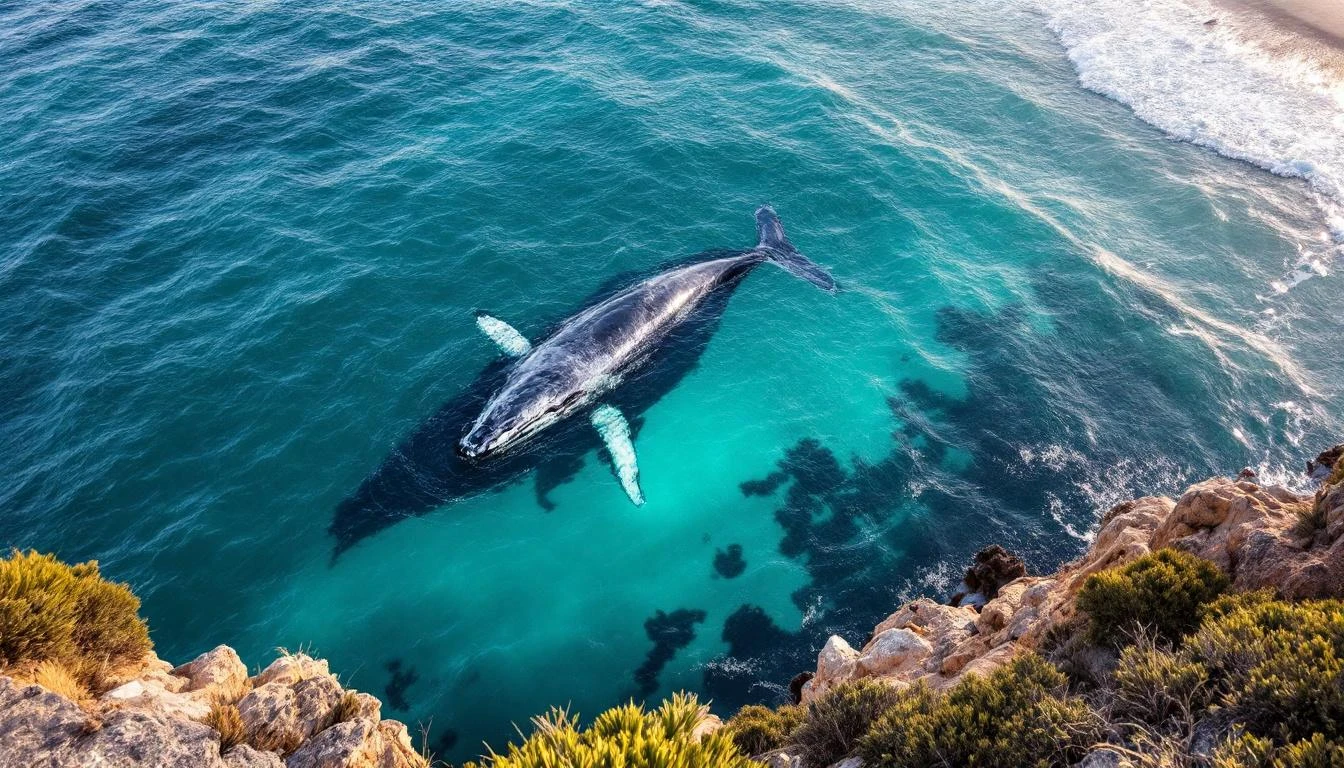
Whale watching on the Great Ocean Road
Southern right whales calve in the shallows at Logans Beach Warrnambool every winter — one of the few places in the world where you can watch newborns and mothers from a clifftop platform.
Why southern right whales return to Warrnambool
Southern right whales spend their summers feeding in the cold sub-Antarctic waters south of Australia. Each winter they migrate north to calve in warmer, sheltered shallow waters along the southern Australian coast. Logans Beach in Warrnambool — at the western end of the Great Ocean Road — is one of the most consistent calving grounds in the country.
The shallow water near the beach (only 5–10 metres deep) protects newborn calves from predators and provides calmer conditions for the mothers. The whales typically arrive in late May or early June, with mothers giving birth and remaining in the shallows for 8–12 weeks before the southward migration in October. During those months, the same individual whales return to the same calving area daily — meaning a single afternoon at the Logans Beach viewing platform can reliably produce sightings of mothers with calves at extraordinarily close range.
The species name "right whale" comes from 19th-century whaling: these were considered the "right" whales to hunt because they swim slowly, float when killed, and produce large quantities of oil and baleen. Hunted to near-extinction by the early 20th century — global population estimates dropped below 100 individuals at one point — the species has slowly recovered under international protection. The southern right whale population now numbers around 12,000 worldwide, with several hundred returning to Australian calving grounds each year.
Logans Beach is the only Australian whale nursery with dedicated public viewing infrastructure, making it accessible to non-boat-tour travellers. The elevated cliff-top platform sits directly above the calving area, giving views that boat tours often can't match.
Logans Beach Whale Nursery, step by step
Logans Beach Whale Nursery is on the eastern edge of Warrnambool, signposted from both directions on the Princes Highway. Drive into the dedicated free car park; from there, a short paved path leads to the elevated cliff-top viewing platform.
The platform has interpretation signs explaining whale biology, the calving cycle, and the broader story of southern right whale recovery. Bring binoculars (8x42 or similar) — even though the whales come close, binoculars dramatically improve the experience. A long telephoto lens (300mm+) is needed for whale photography from this distance.
Visiting in the right window of the season is essential. Late June through late September is the prime period. Earlier or later, sightings drop significantly. The Warrnambool council operates a daily whale information line during the season — call before driving in if travel is long. The platform itself doesn't have a "checking" service; you turn up and see whatever's there. On lucky days, you'll see 3–5 individuals over 30 minutes; on quiet days, occasionally none.
Allow 60–90 minutes minimum. Whales aren't constantly visible — they surface to breathe, then dive for 5–10 minutes. Bring a layer (the cliff is exposed) and patience.
Whale watching from the water
For travellers wanting closer views or different angles, boat tours operate from Warrnambool Harbour during the whale season. Operators run 2–3 hour trips that combine the harbour-area whales with dolphin and seal sightings further offshore.
Cost typically AU$80–120 per person. Tours are weather-dependent and may be cancelled in rough conditions. Booking ahead is essential — small boats fill 1–2 days in advance during peak weeks. The Warrnambool Visitor Centre maintains a current list of operating tour companies.
Whether the boat tour is "better" than the land-based platform depends on what you want. The land platform is free, gives sustained close views of the same individuals across hours, and works in any weather. The boat gets you closer to the actual water surface, sees individuals the platform can't, and produces dramatically different photographs. Many travellers do both during a multi-day stay.
Watching whales responsibly
- Stay on the platform. The cliff edge near the platform is both protected for whale-viewing reasons and dangerous (unstable cliff drops). Don't venture beyond signed areas.
- Don't shout or wave to attract whale attention. The whales are at peace in the shallows; loud disruption changes their behaviour.
- Boat tour operators must keep distance — Australian Marine Mammal Approach Distance regulations require 100 metres minimum from southern right whales. Use only operators that comply.
- Don't drone. Drone disturbance is illegal within marine sanctuary distances and disrupts whale behaviour. The platform produces better photos anyway.
- Don't disturb nursing calves. Mothers with newborns are most vulnerable to disruption.
- Report harassment. If you see boats approaching whales too closely, report to Department of Energy, Environment and Climate Action (DEECA) on 136 186.
Whale watching FAQs
- Where is the best place to see whales on the Great Ocean Road?
- Logans Beach Whale Nursery in Warrnambool — at the western end of the road. Southern right whales return to the warm shallows here every winter to calve, and the elevated cliff-top platform gives free public viewing of mothers and calves at close range. It's one of the few accessible whale nurseries in the world.
- When is whale watching season on the Great Ocean Road?
- Late May to early October. Peak viewing is July to September, when southern right whales are most reliably present at Logans Beach. Numbers vary year-to-year — some seasons see 5–10 individuals, others 1–2. The Warrnambool whale information line (operated by the council) updates daily during the season.
- Are there whale watching tours from Warrnambool?
- Yes — boat tours operate from Warrnambool Harbour during whale season, taking visitors out to view whales from the water. Cost typically AU$80–120 per person for 2–3 hours. The land-based viewing from Logans Beach platform is free and often produces equally good sightings; tours offer different angles and the chance to see other marine life.
- What types of whales can you see?
- Southern right whales are the dominant species — they calve in the shallow protected waters at Logans Beach. Humpback whales pass offshore on their migration but rarely come into the bays. Occasional sightings of orca, dolphins (year-round), and seals (year-round) supplement the main whale season.
- How close do whales come to shore at Logans Beach?
- Surprisingly close — sometimes within 100 metres of the cliff. Mothers with newborns prefer the shallow protected waters to nurse and rest before the open-ocean migration south. The viewing platform is positioned directly above the calving area, giving extraordinary close-range views without disturbing the animals.
- Are there other whale viewing spots on the Great Ocean Road?
- Logans Beach is the main spot. Beyond that, occasional sightings happen at Apollo Bay, Lorne, and from the cliff lookouts along the Shipwreck Coast — but none are reliable enough to plan around. Some whale-watching tours from Apollo Bay run during the season, focused on offshore migration sightings rather than calving.
- Is Logans Beach Whale Nursery free?
- Yes. Free entry, free parking, free public viewing platform. The platform has interpretation signs explaining the southern right whale story, breeding behaviour, and conservation context. There's no ticketing or booking required. Open 24 hours; best in daylight.
- What time of day is best for whale watching at Logans Beach?
- Mid-morning to mid-afternoon, when the sun lights the water clearly. Whales are visible at any time of day during the season, but underwater visibility from the cliff platform is best in good light with low chop. Calmer ocean conditions also help — windy days produce more surface chop that can hide whales below.